Archive for the ‘email’ Category

Compuserve Trademarked the Word “Email” in 1983

Saturday, May 24th, 2008

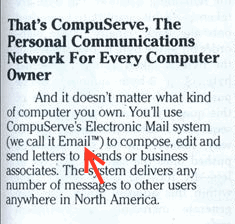
After my comments about old content networks in my previous post about online identity, I had to share this gem about CompuServe attempting to trademark the word “EMail” in 1983. (From Modern Mechanix) Imagine if they had succeeded!
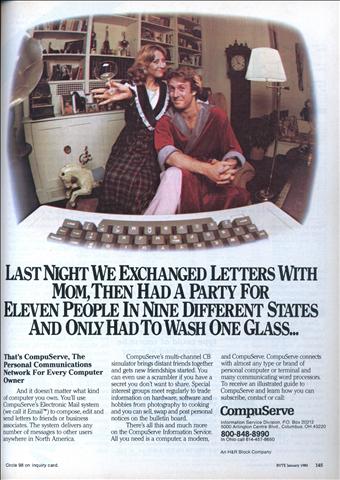


Last Night We Exchanged Letters With Mom, Then Had A Party For Eleven People In Nine Different States And Only Had To Wash One Glass…

That’s CompuServe, The Personal Communications Network For Every Computer Owner

And it doesn’t matter what kind of computer you own. You’ll use CompuServe’s Electronic Mail system (we call it Email™) to compose, edit and send letters to friends or business associates. The system delivers any number of messages to other users anywhere in North America.

A salient point from the CompuServe Wikipedia entry:

As the World Wide Web grew in popularity with the general public, company after company closed their once-busy CompuServe customer support forums to offer customer support to a larger audience directly through company websites…

Social Networks and the Death of Email

Thursday, July 19th, 2007

CNET reports that Email is, like, sooo dead.

When I was in Germany for grad school I was surprised when a classmate said he stayed in touch with faraway friends primarily via IM. “That’s odd”, I replied, “most of my friends aren’t on IM. They just email.”

His reply was short and to the point:

That’s because you’re old, Stan.

Ouch.

But it’s true. Young people do most communication via texting, IM, and social networks.

Eric Rice suggests that this is because of “social authentication. I have to approve you as a contact before you can communicate with me. If I approve someone who is a spammer, I can drop with a single click.

I agree, but this also makes me sad. I don’t mind being contacted by non-friends (or long lost friends) who have a real reason for contact. And I don’t want to have to personally approve each potential contact. That sounds like a lot of work!

The solution is to delegate this “social authentication” out to people I trust. If someone is a friend of my friend, they should be able to contact me with no problem. Likewise, if a friend of mine has identified someone as a spammer, they should be automatically blocked for me. Visually it would look like this:

(That graph comes from my old Outfoxed days, in Keeping your network clean.)

The funny thing is that none of the big social networks employ this technique. LinkedIn comes the closest with their “ask a contact for an introduction to one of their contacts”.

Similar social networked trust solutions could be used for comment spam, product reviews, and even code execution.

That’s my prediction. We’ll see how this plays out.