Archive for the ‘facebook-export’ Category

Family Tech Support Standard Setup for 2012

Thursday, December 22nd, 2011

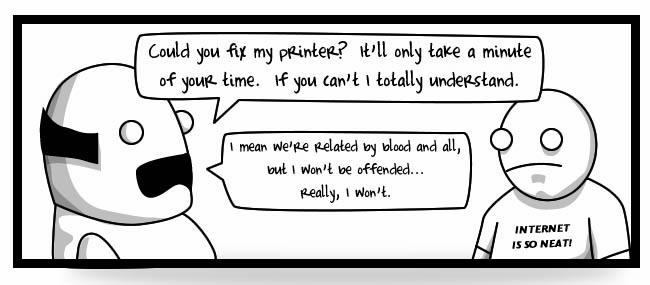
Holidays mean getting together with family, and if you’re the tech guy in the family like me, it also means updating your family’s computers and gadgets. I wrote about my standard setup two years ago, but a lot of things have changed since then. Here is my updated list. This is based on my family which uses primarily Windows, but most of these programs and tips work for Mac as well.

Remote Support: Logmein

If you do nothing else for your family’s computer this holiday, install Logmein. The wonderful program allows you to work on their computer (including seeing what’s on their screen) from anywhere in the world. Even from Germany I could walk my parents in Colorado through sharing a photo of Facebook, or install software updates on my sister’s laptop. (Previously I recommended Microsoft Sharedview, but it requires a complicated dance of logins, invitations, and access codes that was overwhelming to people.)

Anti-Virus: Microsoft Security Essentials

For years I used Avira but in the last months the nag screens became unbearable, popping up every day and with the “close” button hidden by visual tricks. I switched my family to Microsoft Home Security Essentials and have been pleased so far. Be sure to do a full system scan once you’ve installed it, especially if they had no antivirus before.

Broswer: Firefox or Chrome

I’ve kept my family on Firefox even as I’ve moved to Google Chrome, but may move them in this year.

Remove all the bookmarks bar and replace with one’s that make sense for your famliy member. Change the name of each bookmark because the defaults are really long. My standard set is this:

  • Search: Google.
  • Email: Gmail (see below) or whatever web email service (if any) they use.
  • Wikipedia: Wikipedia
  • Maps: Google Maps, with default location set to their home.
  • NewsGoogle News, with local news set to their city.
  • Weather: Weather Underground, with location set to their city.
  • Dictionary: Wordnik, new online dictionary that I worked at. It’s better than the boring dictionary.com in that it also contains slang and unusual words. E.g. my Mom used to learn about “gamification.”
  • Facebook, if they use it.
  • Radio: Pandora. Ask your family member for a few songs or bands they like, and watch as they are amazed at the music that Pandora delivers. (You’ll have to create an account for your friend to save their stations.) My Mom loves listening to Jimmy Reeves.
  • Their bank, local library, and other sites that they might enjoy. My mom loves the OneAcross crossword helper, for example.

Older people can be overwhelmed by the advertising of many sites. Install Adblock Plus add-on to save them from advertising overload.

My parents had a problem with accidentally pressing “F11″ and making Firefox go fullscreen. (F11 is directly above the Backspace key on their keyboard.) Using the Keyconfig add-on you can disable (and add) keyboard functions to solve problems like this.

Photos: Picasa

You’d be surprised how many people I’ve met who have a digital camera but never figured out how to get the pictures onto their computer! I did a lot of research on this one, as my Dad has scanned 10,000+ photos and needs to manage them. (More here) The best free solution has been Picasa from Google. Of course, only install this if they don’t have any image program, or are unhappy with what they are currently using. I find many people are using crappy software that shipped with some product they bought. My Dad, for example, was using a absolutely hideous program from HP that had installed itself with his scanner.

  • If they have been using a different program, or have downloaded images scattered around, move them all to their “My Pictures” folder.
  • Have Picasa then scan only their “My Pictures” folder. Otherwise it will find all sorts of random crap from other programs.
  • Remove the “Blog This” button unless they are a blogger. (Right-click on the button area to configure this.)
  • If your friend uses Gmail, configure the “Email Image” button to work with their Gmail account. If they use a web email other than Gmail, configure Picasa to remove the “Email Image” button.
  • If your friend uses Facebook, install the Facebook Uploader button and connect it with their Facebook account. Very important: Once you have installed the Facebook App, you must do a few extra steps: In Facebook, click on “Applications” in the bottom left, then “Edit Applications”. Change the “Show” option to “Authorized”. Find the “Picasa” application and click “Edit Settings”. Grant the application “Extra Permissions” so that your friend won’t be confused by having a 2nd step where they have to approve uploaded images within Facebook.)
  • Show them how to print an image using the “Print” button at the bottom.

Digital Camera Setup : Eye-fi

My parents could never get the hang of plugging their camera in the computer, or ejecting SD cards. This problem was solved nicely with the ingenius Eye-fi card. You’ll have to set it up for them, but once working, this little card will automatically transfer photos to their computer using their wifi connection. Watch their eyes glow in amazement as a photo appears in Picasa mere seconds after they take a picture. As an added bonus, photos are automatically geo-tagged.

Telephony & Chat: Skype

I’m not a fan of the new version, and who knows what Microsoft will do since they bought it, but Skype remains the safest video chat solution. It gets through most strange firewall situations, and isn’t tied to a specific email provider like Google Talk or Yahoo Video. And at least in my family, it’s what most people already have. Many tech-support sessions consist of a simultaneous Skype call and Logmein remote-control session. This works great, as I can explain what I’m doing while working on their computer in real-time.

  • You’ll have to create an account for your friend. Be sure to give them the login details in case they need it someday.
  • Add as friends any people that you know your friend might want to call.
  • Add a picture to their profile, if you can find one. People like that.
  • To reduce spam for your friend, change the settings to only accept chats or calls from people in their contact list.
  • Configure Skype to login automatically and to launch with Windows.
  • Configure Skype to use their webcam for video and for the microphone.
  • Restart the computer and try making a call to make sure that all the default settings are correct.
  • In all browsers, remove the stupid Skype add-on that is added by default. Sheesh.

Backup: Mozy

This one isn’t free, but Mozy is something that you should encourage them is worth the $5/month. I honestly haven’t used others, but hear good things about Carbonite. You should also setup a local backup using the built-in Windows Backup. If they don’t already have one, go out and buy an external drive to backup to. Storage is cheap these days.

Office: OpenOffice

If they haven’t bought Microsoft Office, they certainly don’t buy it. But of course, they are bound to need to read (and sometimes create) files in Word, Excel, or Powerpoint formats. OpenOffice does a not-great but passable job. As a side note, Gmail has gotten really good at displaying Microsoft document attachements without the user needing any software at all.

  • Important: Change the default saving format to the Microsoft formats. (Yes, we all should support open formats. But believe me, you don’t want to try and explain this to not technical friends. Like it or not, Word and Excel are the de-facto standards.) Go to “Preferences->Load/Save->General”. For each “Document Type” (Text Document, Spreadsheet, Presentation) change the “Always save as” option to “Microsoft XXXXX 97/2000/XP”.
  • Java will be installed as part of this process. Be sure you do NOT get tricked into installing the Yahoo toolbar as part of this. (See Todd’s jihad against toolbars.)

Fun: Google Earth

While maybe not as strictly “useful” as other applications, Google Earth is downright impressive and people, especially older non-technical people, find it to be amazing. Furthermore, your friend can use it to Geotag images in Picasa if they later feel ambitious.

Final System Cleanup

If they’ve been using their system for a while and haven’t had a good tech support person, you’ll have lots of garbage to clean up.

  • Uninstall Java. Lately it has become a nuisance, wanting to update all the time and always trying to slip in the Yahoo browser bar.
  • Remove all shortcuts from the desktop except for Firefox, Picasa, Skype, Google Earth, and programs that your friend specifically mentions using.
  • Check the “Launch at Startup” folder to see what crap may be set to automatically launch. Remove anything that your friend doesn’t actually use.
  • Clean out any toolbars from Internet Explorer and Firefox.
  • Remove links to Internet Explorer from the desktop and start menu. Rename the Firefox shortcut to something like “Web Browser – Firefox”
  • Remove unused programs from taskbar (Windows 7) or the “Start” menu (XP, Vista)
  • Remove unnecesary icons from the system tray.

Playing tech support for a friend or family member is a noble and often thankless task. Good on you for taking it on — it’s a holiday gift that will last the whole year through. If you have other suggestions or ideas, please leave them in the comments.


Me as an Apple computer in 1981

Monday, October 17th, 2011

This post is a shameless attempt to bias the voting in this Retroist poll, and a nod to the influence Apple has had in my life. This was my halloween costume in 1981. My family was living in Okinawa, Japan, and my mom had just read an article about this new computer company with a funny name: Apple.


A zoom shot reveals the brand of this computer / robot:


Little did I know that a few months later, my family would actually buy an Apple computer, forever changing the course of my life. Here is a picture of me working on an early stats package:

Another shameless plug: if you also have cool old photos hanging around, try out my latest little project, Scan with Stan.


And finally, here is a more recent photo of me wearing a jacket that I had custom made in Korea, from my post “I was an Apple Fanboy“.

How sad that now I get the most traffic on this blog from my post, 65 Reasons why Mac Sucks. :)


Thoughts on an email from Dad

Thursday, July 21st, 2011

Many years ago, long before I was born, a particular stream of light burst away from the sun, the result of a nuclear explosion. There’s nothing particularly unusual about this—the sun itself is ongoing nuclear explosion that has been exploding for four and a half billion of years. But I was moved to consider this particular stream last year when I sat down at my laptop and opened an email from my dad. At that moment I was hit with an overwhelming feeling of recognition and amazement. When I think back of all that went into making that feeling possible, I feel amazed all over again.

Like all the light coming from the sun, this particular stream consisted of photons emitted when hydrogen atoms fused together to create helium.(1) This stream of photons left the sun traveling at the usual photon speed of 670 million miles per hour—the speed of light. Yet even at this incredible speed it took them about eight minutes to cover the distance between the sun and the Earth. They didn’t know it, but they were headed for California, and about to hit a barrier.

About the time that light began it’s journey, a little boy was climbing on a pony outside his house in Fillmore, a little town surrounded by Orange groves an hour north of Los Angeles. On that particular afternoon, a photographer was going house to house with the pony offering to take pictures of children.

When the light finally arrived, it hit that boy on the horse. These were very real but very gentle “hits”—it would take trillions of them to have the weight of a feather. Many of these photons were absorbed by the clothes he was wearing, the skin of his face, or the tree behind him. But some of them, depending on their wavelength and surface that they hit, bounced off and continued. And of those photons that bounced, a few of them ended on a particular path through that hot summer air that took them into a piece of glass. This glass bent their course ever so slightly, aiming them at a small rectangle of cellulose film coated with a layer of silver salts. Specks of the film turned dark as the the photons interacted with these salts; salts laid on the film by a process perfected by Eastman Kodak.

Some days later another stream of light would be shown through the film and projected onto a piece of special paper, with the dark spots blocking some of that light. In the end, this paper with patterns of light and dark in just the right places was given to my father’s family. In exchange his mother gave the photographer several green pieces of paper bearing the words “Legal Tender.” She then wrapped the print in a book, along with others, and kept it in the house.

Decades passed, and sometime in 2005 in the mountains of Colorado that particular print was pulled out of the book and placed on a glass plate, just like others my father had pulled out in the previous month. As a motor hummed, bright light from a moving fluorescent bulb below showered millions of photons upward to the print. In an echo of that process many years before, some photons were absorbed and some were reflected. And some of the reflected photons ended up on a course to hit a “Charge-Coupled Device.” In this device the movement of these light photons was converted to movements of electrons. All of those photons in that particular pattern of dark and light were transformed into a pattern of current running across silicon wafers, and eventually through wires in a USB plug and into a computer. The pattern of light was now a pattern of electricity, was now a pattern of bits.

Inside the computer, this pattern of bits was then processed and transformed into a new pattern, one with far fewer bits. Much of this bit-reduction was done by throwing away those bits representing patterns which the camera perceived clearly, but which a human eye could not. This particular bit-reducing procedure was invented in 1992, by the “Joint Photographic Experts Group.” Today it is simply called JPEG.

Inside the computer, this reduced pattern of bits was then pushed out onto a small metal arm hovering above a magnetic disk spinning over five thousand times a second. The the electrons of those bits perched at the tip of this arm caused some of the small magnets in the disk to change direction. The pattern of electricity was now a pattern of magnetism, spinning on a hard disk in my dad’s laptop.

Sometime the next day, at after a mouse click from my father, that small metal arm went to the same spot on the disk and the process went in reverse: the pattern of magnetic spots went back into patterns of electricity. But this time, this electricity set off on a long journey. It left via an ethernet cord, where it went to a router. From there it went to a DSL modem which shifted the pattern onto the telephone wires of my father’s house. This pattern of electricity moved quickly, almost at the same speed that the photons left the sun, crossing the mountainous terrain of northern Colorado on wires hanging from poles 20 feet above the ground. At some point they went underground, and eventually reached a computer belonging to Google’s Gmail service. There is no way of knowing where this computer was, but it probably was not at Google headquarters in California.It is more likely that it landed at one of Google’s huge data centers spread throughout the United States, mostly in places chosen for access to cheap electricity to power.

The very first bits to reach Google represented four letters, spelling out “HELO.” This is the first step in “Simple Mail Transfer Protocol,” which we know as simply “email.” Then came the rest of the bits, containing that special pattern.

Later that day I was sitting on my couch in New York City. It was a tiny apartment in a crumbling century-old building. Two hundred square feet wasn’t much, but it had a magnificent view of the Empire State Building. The bits of data from the Google server—in the same pattern that was on my dad’s computer—zoomed across the country, crossed the Hudson river onto Manhattan, zipped under the city streets, climbed a perilously hanging wire outside my building, and finally passed through a DSL modem and into my laptop.

Another stream of photons,  the last one in this long journey, was flying away from a bright fluorescent light in the back of my laptop. The photons rushed forward—again at that incredible speed. But barely a millimeter later some were blocked by small liquid crystals, rotated into blocking position by electric signals. The crystals were laid out in a grid 15 inches diagonal: 1024 across by 768 down, with three crystals at each point, precisely positioned behind vertical bits of color. Millions of tiny stained-glass windows of red, green, and blue. This pattern of blocking and non-blocking crystals was carefully orchestrated by my laptop to match that received pattern of bits, then piped through the flexible hinge and into the Liquid Crystal Display, or LCD.

The unblocked photos streamed through the color and out of the laptop, crossing a few inches through the air of my apartment before falling on my face. Some tiny percent of them fell on my eye, continuing first through a small plastic contact lens, then through the transparent cornea, on past the brown-colored iris (Which looks green in the right light!), and a few millimeters further their course was ever-so-slightly adjusted by my eye’s lens, pulled into focus by tiny muscles. (My lens is already not as flexible as it used to be. Perhaps in ten years they both will need help from reading glasses?)

On the backside of my eye, the light passed through a thin layer of blood(2), and then into the retina at the back of my eyeball. The blood was there to sustain a layer three special cells; cells tuned exactly to the frequencies of red, green, and blue. (I have to thank my mom for the third variety of cell. My dad, being colorblind, has only two of them.). These cells converted the light into a pattern of small electrical pulses of neurons, each pulse like the firing of a tiny gun. Like a moving highly choreographed wild-west shootout; a train headed to the space between my ears.

This pattern, which had travelled so long and so far, was now in my own body. Small chemical-electrical patterns of my nerves echoed the pattern of scattered light from that sun explosion so many years and eight minutes before.

Once in the brain, different aspects of the image stimulated different parts. Low-level areas in the visual cortex, in the back of my head, responded to edges between dark and light, or that long straight section. Later areas, fed by earlier ones, responded to recognized objects. A horse, a fence, a tree! Half a dog! In the parahippocampal cortex, close to the exact center of my head, the stimulus from the eyes was compared and integrated with my stored memories. And so many memories! Meanwhile, still less than a second after the photons hit my eye, this pattern of neuron firing reached the Fusiform Facial Area. It began firing wildly because it recognized these impulses as having a special sort of pattern: a human face.

Some of these neurons along the visual part of my brain have what are called “mu-opioid” receptors. In fact, these receptors become more numerous in areas handling the more complex patterns. When these receptors were found there in the 1980’s it was a bit of a surprise, since they had previously been found only in brain areas correlated with feelings of pleasure. After all, it is these exactly these receptors which can be tricked into action by smoking Opium.

Activation of even a few would have been enough to draw the attention of my eyes. A level of “pleasure” so low as to be unconscious. But like a secret handshake that gets you into the deepest chambers, this particular pattern passed through almost every visual area of my brain, triggering these mu-opioid receptors all along the way. This gave rise to a now-conscious good feeling. Further neuron firing in a brain area called the Amygdala somehow connected this with my emotions, causing me to smile.(3) 

Somehow I feel a glow of recognition. Somehow a flood of memories is summoned. Somehow I feel a connection between myself and my father. Somehow I feel like I should write him back, and start to think of what I should say.

“Somehow,” yes. But how? It’s here that the trail goes cold, at the boundary between processes and brain-parts I know about, and the mysterious thing I call “me.”

But what a trail it is!

From “me” to my brain. From my eyes to the brain. From the laptop to my eyes. From Google to my laptop. From a house in Colorado to Google. From the photo to his computer. From the film to the photo. From my father’s face to the film. And from the sun to a young boy, sitting on a pony in California.


———-


(1) Okay, to say it was made of photons is not strictly correct, as any modern physicist will tell you how Newton was wrong, and how light is both particles (aka photons) and simultaneously a wave.
(2) If you look at a clear blue sky and defocus your eyes a bit, you can actually see your white blood cells as they pass over. Interestingly, other species have different eyes of “better” design, where blood flows from the back.
(3) For people with the rare disease Capgras, this connection between emotions and vision doesn’t work, leading them to percieve people as imposters. See here.


Featuring Recent Posts WordPress Widget development by YD