Tim Berners-Lee is talking about the Social Graph. This is good, but he and many others are conflating the age-old dream of the “Semantic Web” with the newfound value of the “Social Graph”.
“Social” has come to the web before “Meaning”, because people care more about “social” than “meaning”.
Who said something is infinitely more interesting than what has been said.
What does it benefit a user if the computer can understand the meaning of “Buy Viagra now for cheap! Enlarge your penis!“, but it doesn’t know who said it?
To put it in pictures:
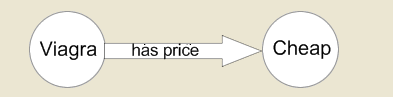
Is it more important that meaning be derived so that the following RDF triplet can “understood” by a computer:
Or, is it more important that the computer realize that this message (no matter the “meaning” or how structured it is.) came from a person/company/source that you don’t know, don’t trust, and have no connection to? (e.g via your social graph)
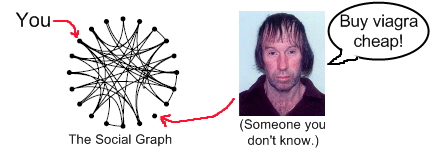
This is why we have applications used by millions of people for throwing food and poo at friends, but no break-through semantic web applications.
(You might argue that people don’t care, that Wikipedia for example is not by any one person in particular. But as I said before, these sorts of facts are not the ones we care about most. You’d much rather get a pie in the face via a Facebook friend than a well-written and structured and meaning-laden bit of text that you have no relation to. (And to be more precise: Wikipedia is a trusted source/brand/company unto itself.))
Back to Berners-Lee, he sees the social graph as exciting because people are finally starting to map something and maybe now they’ll start to map everything else. My criticism is that he views social and trust relationships as only one example of relationships, no more or less important than other relationships. (Like the one in the Viagra-to-Cheap relationship above.) For example, he writes:
So, if only we could express these relationships, such as my social graph, in a way that is above the level of documents, then we would get re-use. That’s just what the graph does for us.
But social/trust relations trump others. This is what I said 3 years ago when beginning Outfoxed, and I’m happy that Facebook and others are proving it true.
Here at Lijit (the company which grew out of Outfoxed), we surface this idea in Search. But it will eventually permeate every aspect of our online lives: message exchange, discovery, shopping, advertising, religion, and more.