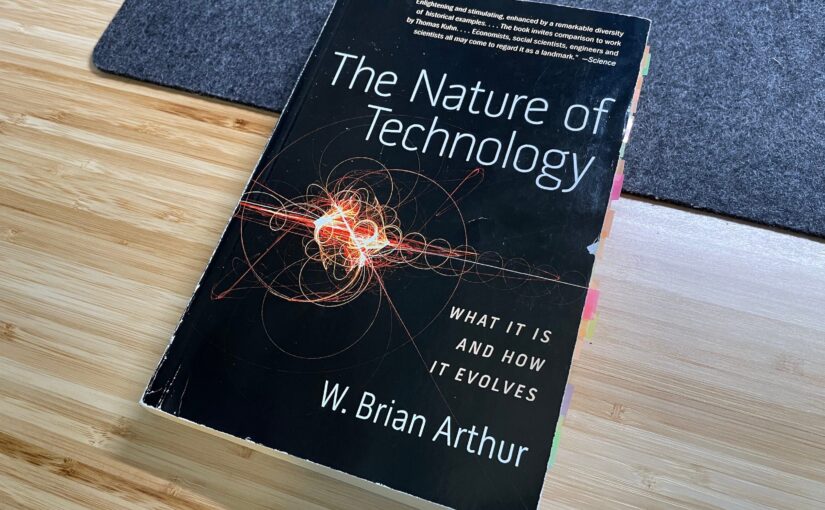
I’ve started reading “The Nature of Technology” by W. Brian Arthur, published in 2009. He’s primarily an economist, so it’s interesting to see his take. As he notes himself, most writing about “Technology” in its most broad sense tends to be critiques and lists of harms it has done. I appreciate that he’s trying to do a judgement-free look at what technology is and how it evolves.
Chapter 2 “Combination and Structure” is the start of his definition. I don’t want to rehash his entire train of thought, but want to note my critique that he is falling into the all-too-comon trap of focussing on (1) material “made of parts” technology and (2) what we would call “high tech”: his examples include jet engines, GPS, and DNA sequencing machines.
He gives only passing attention to the “edges”—where definitions really earn their keep:
Are “chairs” or “beds” technology? If so, is a birds nest a form of technology?
What about seemingly immaterial things like “democracy”, “law”, or “hide-n-seek”? At the close of the chapter he allows that “a [aircraft] carrier group is a technology” as is “the process of distilling whiskey.”
My second critique would be his mention of modularity: that technologies are composed of modular sub-assemblies that serve a purpose. I’m not so sure this is intrinsic as much as it is a concession to human limitations.
The mechanisms of life are famously non-modular, with chemicals and microscoptic structures serving multiple purposes and not being neatly decomposable. Likewise, while the brain has some functions located in general areas, we’ve learned there is no clear “hierarchy of subassemblies.” More interesting when writing this in 2026 is that AI seems to resemble life more than traditional human tech. “It just works” and we don’t know why. I suspect it turns out that the breaking down of technologies into parts that can be easily thought about by a human is only because humans were the ones doing the designing: biological evolution and AI do not share this limitation.